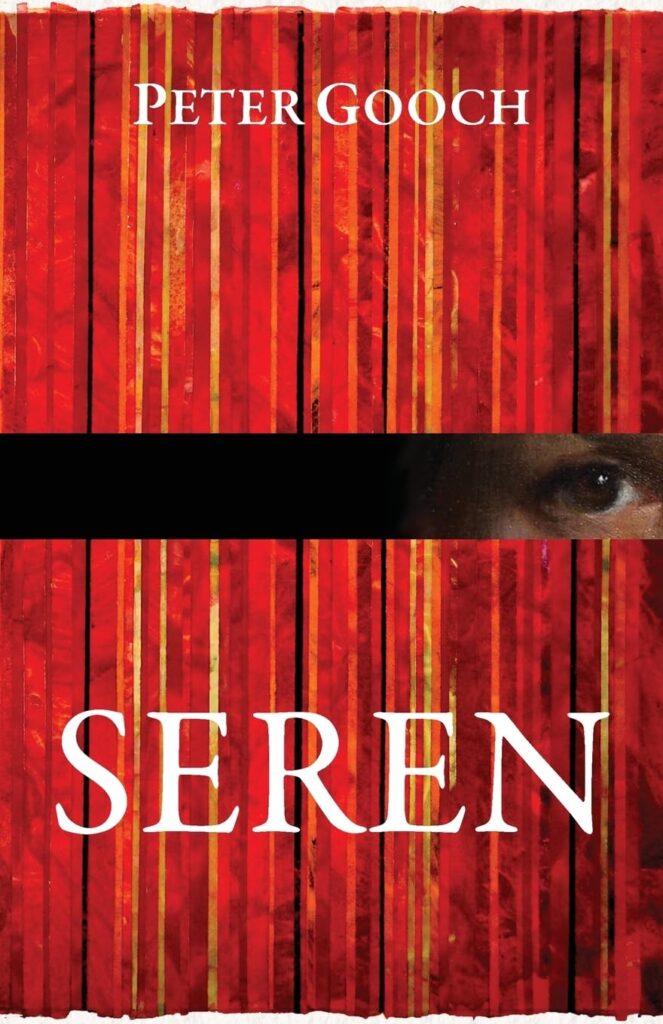
Review of SEREN by Peter Gooch

Apprentice House, 2025. 378 pages. ISBN 978-1627205641.

Review by Emma Greathead


A mysterious painting left in the studio of a deceased artist throws a gallery owner’s comfortable life into turmoil. What begins as a quest for answers spirals into an all-consuming fixation, threatening to rip away Fairchild Moss’s sanity, his romantic endeavors, and the quiet life he’s worked hard to achieve. Set in 1970s Detroit, Peter Gooch’s SEREN is a psychological thriller that explores greed, desire, and a soul-sucking obsession.  

A former artist turned gallery owner becomes transfixed with a painting left behind by the late artist, Norris Bainbridge, just days after Bainbridge’s sudden death. While others barely glance at the painting, dismissing it as a picturesque winter scene, Moss’s eyes keep “returning to a spot six inches in from the left-hand edge where a small circular depression indented the thick impasto of oil paint. Barely visible from a distance more than six feet was the imprint of a female nipple.”  

Bainbridge had no reputation for affairs, public or otherwise, and he never allowed anything as personal as desire to surface through his artwork. The anomaly leaves Moss deeply intrigued. His curiosity takes him through the galleries of Detroit, to the secluded peninsula of Keweenaw, and all the way to Paris as he hunts for the truth behind the painting and the faceless muse who inspired it. His quest begins as a descent through self-discovery, awakening sexual desire, but ultimately leads to Seren—the human embodiment of greed.  

The reader encounters Seren only in small glimpses, though there’s an unmistakable sense of menace surrounding her: “She’s a ghost. No one will notice her haunting the galleries. Mayhap she’ll cross paths with another hungry painter? A sculptor?” … “Her anticipation tastes vaguely of copper, like blood in the lungs.”  

Moss’s eventual encounter with Seren feels like a long-awaited reward. Yet as the tension reaches its peak, that reward shatters into a catastrophic fever dream, disorienting the reader as completely as it does Moss.

For most of the novel, readers are left in the dark about who, or what, Seren truly is, which makes her character all the more fascinating. Moss’s eventual encounter with Seren feels like a long-awaited reward. Yet as the tension reaches its peak, that reward shatters into a catastrophic fever dream, disorienting the reader as completely as it does Moss. After inviting Seren to his secluded cottage in Michigan’s upper-peninsula, Moss experiences a vision, described with: “The beast’s head grew from the pale torso of a child dressed in a bathing costume. Moss recoiled in horror. Before his eyes the face of the animal transformed into that of a young girl, delicate features haloed by heavy black hair.” Gooch delivers a surreal combination of suspense, of horror, of dread. His precision with language and imagery lends to a reading experience that is as hypnotic as it is unsettling. 

SEREN is the closest I’ll get to time travel. Gooch’s ability to pull a reader into the 1970s Midwestern art scene is remarkable—I found myself in Detroit alongside Moss, schmoozing with arrogant art patrons on their expensive yachts, and sitting at the Midtown Café across from the magnetic Claudine, who stole my heart as quickly as she poured Moss’s signature Chartreuse. 

Gooch combines his studies and extensive background in artistry with his accounts of Midwestern art culture, making SEREN an immersive masterpiece with multidimensional characters, vivid scenery, and mysteries that had me glued to the page.

Gooch combines his studies and extensive background in artistry with his accounts of Midwestern art culture, making SEREN an immersive masterpiece with multidimensional characters, vivid scenery, and mysteries that had me glued to the page. I wanted to comfort Moss—and simultaneously to shake some sense into him. His inability to see his own worth (and to see Claudine’s, for Christ’s sake!) made this novel impossible to put down.  

SEREN is not a mystery about a man in search of answers, but a twisted exploration of how desire and ambition can spill chaos across the canvas of existence. Moss is profoundly lonely, unmoved by status, wealth, or sex. He turns down staggering offers for the Bainbridge panting, hesitates to pursue romantic connections, and retreats to the shadows of his own gallery where he allows his assistant director to manage the demands of the outside world. What drives him instead is a deep, aching hunger for meaning—a painful yearning to become the artist he’d once been. Even as his creativity is rekindled through the motivation of Claudine, Moss remains unsatisfied. He reaches for something beyond him, and gradually, the Bainbridge painting transforms into a mirror for that longing.  

Moss’s journey takes him beyond the Bainbridge painting, turning into a path of self destruction fueled by his secret artistic yearning. His relationship with Seren, the enigmatic muse who holds the answers to his quest for knowledge, explores the dangerous imbalance between obsession and creation. It poses a haunting question: at what point does fascination become so consuming that one is willing to forsake the people who helped and guided them?


Peter Gilchrist Gooch is a painter, writer, and former art professor living in New Mexico. He is the author of the novel Seren (Apprentice House Press—winner: Best First Book from the New Mexico Book Awards) and the novel LIPS (Atmosphere Press—Five Stars from Literary Titan). His short fiction has appeared in numerous literary magazines and online. Originally from Ann Arbor, Michigan, he holds an MFA in painting from Western Michigan University. Currently, Prof. Gooch resides in Corrales with his wife, Dr. Sharon Ransom. Visit petergoochauthor.com.


Emma Greathead is pursuing her Bachelor’s degree in creative writing at Western Michigan University. She completed an internship with Third Coast in Fall 2025 and has a forthcoming publication in the Red Cedar Review. When she isn’t writing her own fiction, Emma enjoys weightlifting and exploring coffee shops.

Maneater

by Patrick J. Zhou


Cousin is either on the spectrum or is very Chinese. Or, like most men, lacks social skills. Maybe it’s the newness, the spectacle, the intimidating performance of it all. Whatever the reason, Cousin declares his presence to the surrounding pews when he asks out loud in Mandarin, “What do people taste like?”

Before I can say anything, Mother, who’s been quietly translating the worship service into Cousin’s ear, whispers, “Show lovingkindness.” Her jujube-wrinkled forehead tilts—a reminder that mothers know their daughters. Cousin, meanwhile, bumps my shoulder as he necks for a good view of the chancel.

But on our trudge to the table too white and chaliced for a good old-fashioned butchering, Cousin slouches; the symbolism and all the hidden meanings in this place get him again. To cheer him up—or something—I whisper little catechisms, teach him some secrets. I explain the sacrament, the eating of no-longer bread but Godmeat, drinking no-longer wine but the transformational blood of Triune God, and I tease a feigned grimace when I warn him how dangerous it is for non-believers to eat it. “You never know what might happen,” I say of the charade. Obviously, it’s all a crock. My prodigal presence was Mother’s idea, her first rule, or punishment, for moving back into her house at twenty-seven years old. The second rule: Be a good cousin.

But a little fun never hurt anyone.

As the pastor gives Cousin the host, his mouth open like a whale, Cousin clamps a callow hand in mine. The hunger pulses through his clenched fingers, this thirst for communion, for a substance he won’t find here and, suddenly, I see all the bitterness he hasn’t swallowed. It’s why they all come here don’t they, having been sold an idea of a better place, of refuge. There’s something free in his complete lack of contempt, some sweetness in that living. Is it really naïveté, or is it my cynicism spitting on the different world of his experience? Meanwhile, mother’s pithy religious truisms susurrate in my ears like a mosquito: “Love is patient” or “The fruit of the spirit is” or “Love covers a multitude of sins”, etc. My only revelation then though, the only sin I want forgiven, is being cruel to Cousin. So I let him hold my hand while he skips back to our pew.

Choir voices raise to the oak-beamed vault. Their haunting chant bounding off the stained glass and the old oak doors. That’s when Cousin’s face lurches, squelches. By instinct, my palms shoot out and quietly catch a teacup’s worth of his vomit. Cousin doesn’t notice, doesn’t mention what I hold. He’s too displeased at being made a new creation. “Disgusting,” he says, under the amens thrumming through the sanctuary. Then I feel something weighty in my hands; there, surrounded by a warm ferrous puddle of scarlet, a small chunk of flesh glistens, topped with a shred of flayed skin.

Mother leans over and across Cousin, who’s smacking the sticky taste off his tongue like an infant. She sees the horrific miracle in the hollow of my hands, and whispers with the smugness only mothers achieve, “Something strange will save you, baby.”


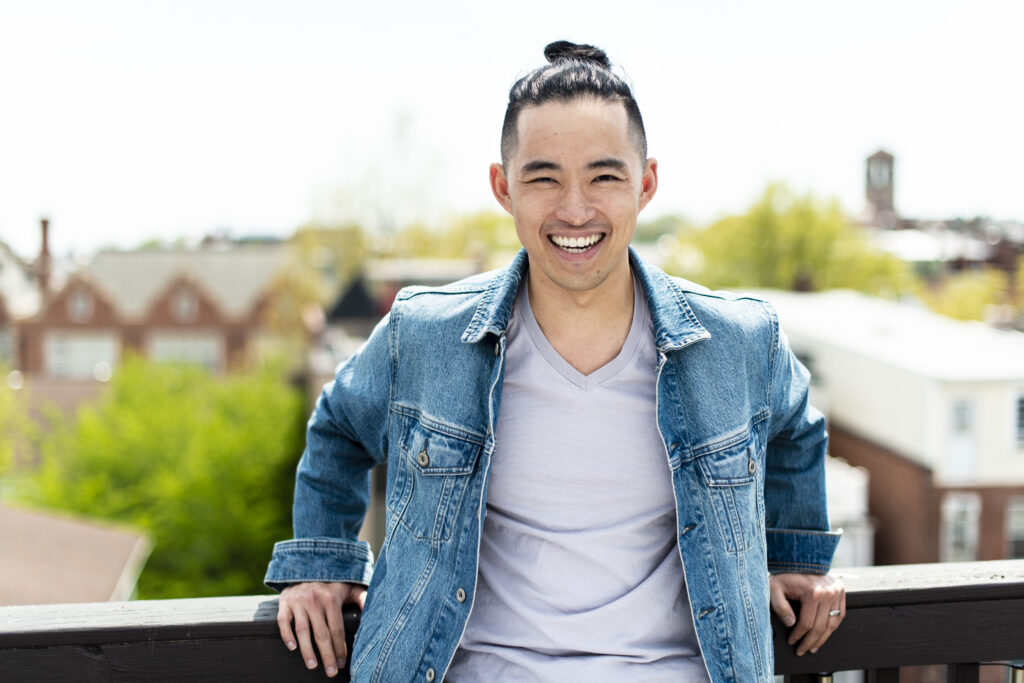
photo of author Patrick J. Zhou smiling and leaning casually against a railing.

Patrick J. Zhou lives in Washington, D.C. and has stories published in
or forthcoming from The Cincinnati ReviewBennington ReviewQuarterly Westhex literary, and more. A winner of the 2023 PEN/Dau Short Story Prize for Emerging Writers and the 2024 Robert and Adele Schiff Award for Fiction, he adds notes about his stories at patrickjzhou.com along with pictures of his gray cat Bobby Newport.

The Seamstress

by Sara Elkamel

for Huda Lutfi


SARA ELKAMEL holds an MA in arts journalism from Columbia University and an MFA in poetry from New York University. She is the author of the poetry chapbooks Field of No Justice (African Poetry Book Fund & Akashic Books, 2021) and Garden City (Beloit Poetry Journal, 2026). Her translations of poetry include Mona Kareem’s chapbook, I Will Not Fold These Maps (Poetry Translation Centre, 2023) and Dalia Taha’s Enter World (Graywolf Press, 2026). She lives in Cairo.

Q&A with Dustin M. Hoffman, Fiction Contest Judge

This spring, the 2026 Fiction Contest is judged by Dustin M. Hoffman. Dustin M. Hoffman writes fiction about working people. He’s the author of three short story collections: One-Hundred-Knuckled Fist (University of Nebraska Press, winner of the 2015 Prairie Schooner Book Prize), No Good for Digging (Word West Press), and, most recently, Such a Good Man (University of Wisconsin Press). He has published more than one hundred stories in journals including Black Warrior Review, Alaska Quarterly Review, Ninth Letter, Witness, Wigleaf, The Threepenny Review, Gulf Coast, and One Story. We asked Hoffman a few questions about how writing contests have helped shape his career, how to decide if a piece is ready to submit, and what piques his interest as a reader.

Dustin M. Hoffman (DMH): My first book, One-Hundred-Knuckled Fist, won the Prairie Schooner Raz/Shumaker Book Prize, and it was life changing. My weird stories about working people found pages and found readers thanks to the support of University of Nebraska Press. My wonderful agent, Heather Carr, contacted me after reading this first book, which started our partnership that I treasure. For a short story writer like me, writing contests present an especially important opportunity to support the form I love so dearly, a form that might find a harder time reaching readers if not for contests with small presses and journals. I’ve been so lucky to win a couple short story contests at great magazines (Redivider and Ninth Letter). The financial support is not insignificant, and I aimed to reinvest the prize money back into my writing by buying a ton of books and paying for submission fees and just affording some time to make more art.

So, there are very practical rewards, of course, in the financial support and audience. But let’s not neglect, too, how contests offer this incredible psychological boost. We’re all spending these countless hours rattling thousands of words into a computer, deleting most of them, reshaping the rest again and again, and it’s easy to slip into feeling like these efforts might be in vain. The validation contests offer from hardworking editors and generous judges provides that beacon writers need to keep at this, to write our next great story that might have remained undiscovered.

But let’s not neglect, too, how contests offer this incredible psychological boost. We’re all spending these countless hours rattling thousands of words into a computer, deleting most of them, reshaping the rest again and again, and it’s easy to slip into feeling like these efforts might be in vain. The validation contests offer from hardworking editors and generous judges provides that beacon writers need to keep at this, to write our next great story that might have remained undiscovered.

DMH: My students ask me this a great deal, and I do think this is a wonderful thing a trusted teacher or writer friend can offer: the confirmation that the work is ready to go out into the world. But I still ask myself this every time I write a story. I go through so many drafts, and that’s the place a story always comes alive for me, in the revising. Sometimes it’s twenty drafts and sometimes it’s ten years, and sometimes the stories come together like magic. I’m a fan of reading a work aloud to see if it entertains me after I’ve set it aside for a while. So much of what’s worked for me is getting outside my story, separating in some way with time or voice or audience. Failing that, I love the piece of advice from Noy Holland, “If I reach a point where I am glazing over, or replacing, one day, a comma I omitted the day before, then I let the story go, for better or worse, and move on.”

I want new. I want weird. I want the story I could never have imagined would be possible. 

DMH: Oh, it might affect me some. I come from a working-class background. I write about jobs and the anxiety of money a great deal, because this has been such a big part of my life, and I tend to appreciate when writers recognize this part of living in our world that works us too hard. But I don’t come to reading to relate to a work. I want to learn about people’s unique experiences and cultures and voices. I want new. I want weird. I want the story I could never have imagined would be possible. 


DMH: I love work stories and the specialized language and secret details that only someone who dwells behind the “Employees Only” can know. I also love surreal and magical works. Maybe the secret to my readerly heart is humor. It’s the gateway emotion. If you can make me laugh first, I’m willing to go just about anywhere with you. 

DMH: I’m always reading too many books at once. What I’m reading right now: Philip Roth’s American Pastoral. Two of my amazing colleagues’ books: Renée Branum’s Defenestrate and Allison Joseph’s Dwelling; I consider myself ridiculously lucky to be working with these geniuses. Adam Schuitema’s forthcoming novel Half a Million Minutes (it’s incredible!). And I just finished up Miranda July’s collection No One Belongs Here More Than You after loving All Fours

Dustin M. Hoffman writes fiction about working people. He’s the author of three short story collections: One-Hundred-Knuckled Fist (University of Nebraska Press, winner of the 2015 Prairie Schooner Book Prize), No Good for Digging (Word West Press), and, most recently, Such a Good Man (University of Wisconsin Press). He has published more than one hundred stories in journals including Black Warrior ReviewAlaska Quarterly ReviewNinth LetterWitnessWigleafThe Threepenny ReviewGulf Coast, and One Story. Before getting his MFA in fiction from Bowling Green State University and his PhD in creative writing from Western Michigan University, he spent ten years painting houses in Michigan. He currently teaches at Southern Illinois University Carbondale. Find his author website here: https://dustinmhoffman.com/ 

Q&A with Karyna McGlynn, 2026 Poetry Contest Judge

This spring, the 2026 Third Coast Poetry Contest is judged by Karyna McGlynn. Karyna McGlynn is a queer writer, visual artist, and educator, and the author of three poetry collections from Sarabande Books, including 50 Things Kate Bush Taught Me About the Multiverse (Lambda Literary Finalist) and Hothouse (NYT Editor’s Choice). They are Director of Creative Writing at Interlochen Center for the Arts. We asked McGlynn a few questions about how writing contests have supported their career, how to decide if a piece is ready to submit, and what piques their interest as a reader.

Karyna McGlynn (KM): Writing contests have been genuinely formative for me. Not just in terms of recognition, but in helping me stay in the long, often quiet middle of a writing life. Early on, even being longlisted or shortlisted helped my work become legible beyond my immediate community: editors reached out, conversations started, doors cracked open. Just as important was the confidence boost—those small external signals that I was connecting with people across the page. 

Submitting work (imperfectly, bravely) is a muscle we have to build and maintain. To say “I’m a writer” is also to say “I’m willing to let my work be read and considered.” Contests create a focused, meaningful occasion for that practice, and they remind us that putting work into the world is part of the art.

Equally vital is the practice itself. Submitting work (imperfectly, bravely) is a muscle we have to build and maintain. To say “I’m a writer” is also to say “I’m willing to let my work be read and considered.” Contests create a focused, meaningful occasion for that practice, and they remind us that putting work into the world is part of the art.

KM: I usually say: it should feel finished enough that you’ve made all the decisions you know how to make right now, but not so precious that rejection would stop you from writing the next thing. If you’re mostly tinkering rather than discovering anything new, that’s often a sign the piece is ready to leave home.

I also encourage writers to ask a more useful question than “Is it perfect?” How about: “Is this piece doing what it wants/needs to do?” If the answer is yes (or even a confident “mostly”), that’s enough for now! Submission isn’t a verdict. Submit your work to things. If you receive a slate of rejections, come back to it later with fresh eyes. 

KM: Your title is basically the first line of your poem; it needs to be strong. Don’t waste that opportunity to situate the reader and/or establish the attitude or problem of the poem. Poets are supposed to be masters of evocative compression; prove it with your title. 

I’m deeply drawn to musicality—language that has sick textures and sonics and rhythms. I’m most excited when sound is married to voice, risk, and visual specificity. I want to feel the poem leaning toward something it doesn’t already know.

My biggest piece of advice is to be more specific. Too many poems are full of vague abstraction and emotional shorthand. Think of yourself like a film director. Are you giving your readers a world to inhabit? Are there enough sensory details for them to feel transported?  

I’m deeply drawn to musicality—language that has sick textures and sonics and rhythms. I’m most excited when sound is married to voice, risk, and visual specificity. I want to feel the poem leaning toward something it doesn’t already know.

I’m not looking for a particular subject or style. I read widely and eclectically, and I’m always surprised by what hooks me. What I love most is work that trusts its own strangeness, that doesn’t rush to explain itself, and that feels awake to the pressures that shaped it. 


Karyna McGlynn is a writer, visual artist, and educator, and the author of three poetry collections from Sarabande Books, including 50 Things Kate Bush Taught Me About the Multiverse (Lambda Literary Finalist), Hothouse (New York Times Editor’s Choice), and I Have to Go Back to 1994 and Kill a Girl (Kathryn A. Morton Prize). Their work appears in Poetry Magazine, Kenyon Review, New England Review, and elsewhere. McGlynn is Director of Creative Writing at Interlochen Center for the Arts and was recently Visiting Distinguished Professor of Poetry in the Helen Zell Writers’ Program at the University of Michigan.

Ode to my Yucatán Gecko

by Ingrid Wendt

“Ode to My Yucatán Gecko” appears in Issue 55/56 of Third Coast, forthcoming Spring 2026


Review of WE HAD MANSIONS by Mandy Shunnarah

Diode Editions, 2025. $18.00 (paperback), ISBN: 978-1-939728-70-8

Review by Ella Reynolds


 An achingly raw and intimate collection of personal experience and docupoetics, We Had Mansions, written by Mandy Shunnarah, combines the historical background of Palestine and its people with Shunnarah’s own unique, modern-day experience, resulting in a work that is as beautiful as it is unflinchingly defiant in the face of discrimination and attack.  

Shunnarah’s debut poetry collection We Had Mansions is simultaneously a love song and a lament: it is a celebration of Shunnarah’s Palestinian heritage, queerness, positive body image, and love. It also explores Shunnarah’s complex struggles with being a queer Palestinian in America, their complicated relationship with religion, and acts as a testament to the continuing hardships faced by Palestinians all over the world. Although We Had Mansions illustrates the hurts Palestinians have suffered and continue to suffer as a result of displacement and genocide with raw candor, it is not a poetry collection about suffering; it recognizes resilience and honors the love and hope that continues to be ever-present in Palestinian culture.

Shunnarah’s poetry is marked by a confessional voice, drawing on personal experience and emotional vulnerability; the subject matters of their poems are deeply personal to them, and the importance of these topics is evident through the raw, uninhibited, and candid way in which they are described, as if they are confiding in the reader. The poetry collection opens with a couplet: “Sedo told me once our last name means partridge—/that sweet little bird in the pear tree every Christmas” (19). Later in the poem, Shunnarah describes how partridges are land-dwelling birds, and that they were “put in pear trees against their will—branches like an open air prison/the world ignores because at least they can still see the sky” (19). The confessional voice is established through the mention of “Sedo,” an Arabic word which means “grandfather.”. Shunnarah’s grandparents, who moved from Palestine to America, are constants in We Had Mansions. Their recurrence establishes their immense importance in Shunnarah’s childhood as well as their adult life, acting as physical manifestations for Shunnarah’s Palestinian heritage, their connection to their homeland, generational trauma and gender roles, and the preservation of culture. Shunnarah writes that their “grandfather didn’t want to leave the old country,” but felt as if “to escape exile he had to exile himself” (24).  

Although We Had Mansions illustrates the hurts Palestinians have suffered and continue to suffer as a result of displacement and genocide with raw candor, it is not a poetry collection about suffering; it recognizes resilience and honors the love and hope that continues to be ever-present in Palestinian culture.

By sharing the history of their family, Shunnarah is both creating a space for emotional vulnerability to exist between themself and the reader and offering background information that is vital to understanding the unique relationship they have with their heritage. Shunnarah longs for the land their grandparents fled from, which they did not out of a lack of love for Palestine, but out of hope that America would offer opportunities to themselves and their children. By divulging their grandparents’ story, Shunnarah fosters an emotional relationship with the reader, which in turn allows the reader to better understand Shunnarah’s experience and identity as a Palestinian.  

Their confessional voice also enables them to speak candidly about their relationship with gender, body image, and religion, and in doing so minimizes the space between the poet and the poetry. On the topic of their body, they refer to their stretch marks as “tabby stripes,/a vertical shimmer where skin grew to accommodate more of me,” allowing the reader to be privy to vulnerable and personal details about themself not only as a poet but also as a person (30). Similarly, their relationship with and ideas about religion and the connection it shares with Palestine is the subject matter of multiple poems such as “the great falastini,” “everyone’s favorite palestinian,” and “jesus was trans,” which also touch upon the idea of gender. Shunnarah’s hope for Palestinian voices to be heard and for their humanity to be recognized by the world is achieved through the confessional voice that marks their poetry. 

Shunnarah’s We Had Mansions also includes a variety of forms of poetry, ranging from open, free-verse to more close-structured forms. Their use of ghazals and odes in particular establishes the themes of longing, loss, love, and celebration that are present throughout the collection. The ghazal form is often used to convey melancholy, love, loss, and other similar emotions, which are key themes in poems such as “prayer ghazal,” an expostulation on how Arabs welcomed refugees who then colonized them, and “a falling in love ghazal,” a tender poem about the poet’s love for their beloved, each couplet ending with “habibi”, which translates to “my love.” 


Shunnarah writes in the ode form not only to celebrate ideas, but to ignite conversation and to encourage the dismantling and reforming of patriarchal systems in society.  

Odes are also a recurring form in We Had Mansions, which are often used to celebrate a person, place, thing, or concept. In “ode to short nails,” Shunnarah illustrates and celebrates queerness, particularly in AFAB individuals, by using the ode form to amplify the significance of fingers and fingernails in the sapphic scene. This ode celebrates Shunnarah’s identity as a queer individual as well as sapphism on a larger scale; similarly, “ode to cows and clitorises” is a poem about female sexuality that acts as a raw commentary on the lack of research in modern medicine for women. Shunnarah writes in the ode form not only to celebrate ideas, but to ignite conversation and to encourage the dismantling and reforming of patriarchal systems in society.  

We Had Mansions is a collection of poetry that encapsulates not only Shunnarah’s experience as a Palestinian in America, but as a Palestinian who is queer, as a Palestinian who has loved and lost, as a Palestinian who struggles and overcomes again and again—that is to say, as a human. Shunnarah’s confessional voice and their use of a variety of poetic forms creates a bond between poet and reader that ultimately fosters a space of emotional vulnerability, and in doing so causes the already-forthright subject matters of their poems to evolve further in intensity. 


Mandy Shunnarah (they/them) is an Alabama-born, Appalachian and Palestinian-American writer who now calls Columbus, Ohio, home. Their essays, poetry, and short stories have been published in The New York Times, Electric Literature, The Rumpus, and others. Their first book, Midwest Shreds: Skating Through America’s Heartland, was published in July 2024 by Belt Publishing. Their second book, a poetry collection titled We Had Mansions, is forthcoming from Diode Editions in 2025. Read more at mandyshunnarah.com.


Ella Reynolds is an undergraduate at Western Michigan University pursuing a degree in English Literature and Language with a double minor in Classical Studies and Marketing. She completed an internship with Third Coast in Fall 2025. In addition to coursework, she writes for the university newspaper and enjoys attending live music shows.