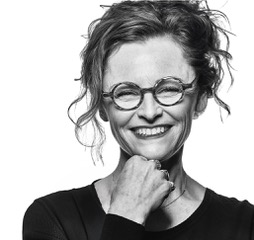
This spring, the 2026 Third Coast Poetry Contest is judged by Karyna McGlynn. Karyna McGlynn is a queer writer, visual artist, and educator, and the author of three poetry collections from Sarabande Books, including 50 Things Kate Bush Taught Me About the Multiverse (Lambda Literary Finalist) and Hothouse (NYT Editor’s Choice). They are Director of Creative Writing at Interlochen Center for the Arts. We asked McGlynn a few questions about how writing contests have supported their career, how to decide if a piece is ready to submit, and what piques their interest as a reader.
Third Coast (TC): How has support from writing contests helped to shape your career? What value do you see in submitting to writing contests?
Karyna McGlynn (KM): Writing contests have been genuinely formative for me. Not just in terms of recognition, but in helping me stay in the long, often quiet middle of a writing life. Early on, even being longlisted or shortlisted helped my work become legible beyond my immediate community: editors reached out, conversations started, doors cracked open. Just as important was the confidence boost—those small external signals that I was connecting with people across the page.
Submitting work (imperfectly, bravely) is a muscle we have to build and maintain. To say “I’m a writer” is also to say “I’m willing to let my work be read and considered.” Contests create a focused, meaningful occasion for that practice, and they remind us that putting work into the world is part of the art.
Equally vital is the practice itself. Submitting work (imperfectly, bravely) is a muscle we have to build and maintain. To say “I’m a writer” is also to say “I’m willing to let my work be read and considered.” Contests create a focused, meaningful occasion for that practice, and they remind us that putting work into the world is part of the art.
TC: What advice do you give to a writer who’s wondering, “Is my piece ready to submit?”
KM: I usually say: it should feel finished enough that you’ve made all the decisions youknow how to make right now, but not so precious that rejection would stop you from writing the next thing. If you’re mostly tinkering rather than discovering anything new, that’s often a sign the piece is ready to leave home.
I also encourage writers to ask a more useful question than “Is it perfect?” How about: “Is this piece doing what it wants/needs to do?” If the answer is yes (or even a confident “mostly”), that’s enough for now! Submission isn’t a verdict. Submit your work to things. If you receive a slate of rejections, come back to it later with fresh eyes.
TC: As a judge, what kind of work most often piques your interest? Is there anything you’d love to see from entrants?
KM: Your title is basically the first line of your poem; it needs to be strong. Don’t waste that opportunity to situate the reader and/or establish the attitude or problem of the poem. Poets are supposed to be masters of evocative compression; prove it with your title.
I’m deeply drawn to musicality—language that has sick textures and sonics and rhythms. I’m most excited when sound is married to voice, risk, and visual specificity. I want to feel the poem leaning toward something it doesn’t already know.
My biggest piece of advice is to be more specific. Too many poems are full of vague abstraction and emotional shorthand. Think of yourself like a film director. Are you giving your readers a world to inhabit? Are there enough sensory details for them to feel transported?
I’m deeply drawn to musicality—language that has sick textures and sonics and rhythms. I’m most excited when sound is married to voice, risk, and visual specificity. I want to feel the poem leaning toward something it doesn’t already know.
I’m not looking for a particular subject or style. I read widely and eclectically, and I’m always surprised by what hooks me. What I love most is work that trusts its own strangeness, that doesn’t rush to explain itself, and that feels awake to the pressures that shaped it.
Karyna McGlynn is a writer, visual artist, and educator, and the author of three poetry collections from Sarabande Books, including 50 Things Kate Bush Taught Me About the Multiverse (Lambda Literary Finalist), Hothouse (New York Times Editor’s Choice), and I Have to Go Back to 1994 and Kill a Girl (Kathryn A. Morton Prize). Their work appears in Poetry Magazine, Kenyon Review, New England Review, and elsewhere. McGlynn is Director of Creative Writing at Interlochen Center for the Arts and was recently Visiting Distinguished Professor of Poetry in the Helen Zell Writers’ Program at the University of Michigan.
The first time ever I heard your six-note chatter from deep
inside my palm-thatched roof, no more than five minutes past
lights-out, ping went the strings of attraction. No night passed
without your bedtime serenade, and when at last we met—your tiny feet
spread wide on the bathroom ceiling, your tender skin nearly translucent (between
your oversized eyes and mine, invisible lightning)—I finally grasped
the measure of your devotion: not a bug to be seen, you were shielding
my skin from irritation, as you also do outside, under the naked bulb that attracts
even more of them, as does Maribel’s bulb, next door, though why Maribel had fifteen
of you one evening, when I came to call, I cannot fathom.
But that same night at bedtime, as if this were an elegant, grand
hotel, centered on my pillow, instead of a candy kiss, your greeting:
a small, black grain of rice with a tiny, white hat. Look at that, I preened,
and went to my desk to write it down. And when the sun again splashed
the eastern horizon, there, on my desk, the second! Of all the umpteen,
randomly scattered pages, you’d chosen “Yucatán Gecko.” Who needs
fifteen suitors competing? Eat your heart out, Maribel. My Yucatán gecko has sass.
“Ode to My Yucatán Gecko” appears in Issue 55/56 of Third Coast, forthcoming Spring 2026
Eugene (Oregon) poet Ingrid Wendt is the author of five books of poems and co-editor of two anthologies. Trained in classical piano and organ, her honors include the Oregon Book Award, four Pushcart nominations, several features on Garrison Keillor’s “The Writer’s Almanac,” and three Fulbright professorships in Germany. A member of the Eugene Concert Choir and a volunteer interpreter at the Oregon Coast Aquarium, Wendt’s recent poems appear in Poetry, About Place, American Poetry Review, Terrain, Tikkun, River Heron Review, and on torhouse.org, as an honorable mention in the 2025 Robinson Jeffers Tor House Prize in Poetry. Her newest collection, Keeping It All Afloat, will be released February 1st from MoonPath Press. For pre-orders, go to Amazon, B&N, and Bookshop. org. Visit https://ingridwendt.com.
An achingly raw and intimate collection of personal experience and docupoetics, We Had Mansions, written by Mandy Shunnarah,combines the historical background of Palestine and its people with Shunnarah’s own unique, modern-day experience, resulting in a work that is as beautiful as it is unflinchingly defiant in the face of discrimination and attack.
Shunnarah’s debut poetry collection We Had Mansions is simultaneously a love song and a lament: it is a celebration of Shunnarah’s Palestinian heritage, queerness, positive body image, and love. It also explores Shunnarah’s complex struggles with being a queer Palestinian in America, their complicated relationship with religion, and acts as a testament to the continuing hardships faced by Palestinians all over the world.Although We Had Mansions illustrates the hurts Palestinians have suffered and continue to suffer as a result of displacement and genocide with raw candor, it is not a poetry collection about suffering; it recognizes resilience and honors the love and hope that continues to be ever-present in Palestinian culture.
Shunnarah’s poetry is marked by a confessional voice, drawing on personal experience and emotional vulnerability; the subject matters of their poems are deeply personal to them, and the importance of these topics is evident through the raw, uninhibited, and candid way in which they are described, as if they are confiding in the reader. The poetry collection opens with a couplet: “Sedo told me once our last name means partridge—/that sweet little bird in the pear tree every Christmas” (19). Later in the poem, Shunnarah describes how partridges are land-dwelling birds, and that they were “put in pear trees against their will—branches like an open air prison/the world ignores because at least they can still see the sky” (19). The confessional voice is established through the mention of “Sedo,” an Arabic word which means “grandfather.”. Shunnarah’s grandparents, who moved from Palestine to America, are constants in We Had Mansions. Their recurrence establishes their immense importance in Shunnarah’s childhood as well as their adult life, acting as physical manifestations for Shunnarah’s Palestinian heritage, their connection to their homeland, generational trauma and gender roles, and the preservation of culture. Shunnarah writes that their “grandfather didn’t want to leave the old country,” but felt as if “to escape exile he had to exile himself” (24).
Although We Had Mansions illustrates the hurts Palestinians have suffered and continue to suffer as a result of displacement and genocide with raw candor, it is not a poetry collection about suffering; it recognizes resilience and honors the love and hope that continues to be ever-present in Palestinian culture.
By sharing the history of their family, Shunnarah is both creating a space for emotional vulnerability to exist between themself and the reader and offering background information that is vital to understanding the unique relationship they have with their heritage. Shunnarah longs for the land their grandparents fled from, which they did not out of a lack of love for Palestine, but out of hope that America would offer opportunities to themselves and their children. By divulging their grandparents’ story, Shunnarah fosters an emotional relationship with the reader, which in turn allows the reader to better understand Shunnarah’s experience and identity as a Palestinian.
Their confessional voice also enables them to speak candidly about their relationship with gender, body image, and religion, and in doing so minimizes the space between the poet and the poetry. On the topic of their body, they refer to their stretch marks as “tabby stripes,/a vertical shimmer where skin grew to accommodate more of me,” allowing the reader to be privy to vulnerable and personal details about themself not only as a poet but also as a person (30). Similarly, their relationship with and ideas about religion and the connection it shares with Palestine is the subject matter of multiple poems such as “the great falastini,” “everyone’s favorite palestinian,” and “jesus was trans,” which also touch upon the idea of gender. Shunnarah’s hope for Palestinian voices to be heard and for their humanity to be recognized by the world is achieved through the confessional voice that marks their poetry.
Shunnarah’s We Had Mansions also includes a variety of forms of poetry, ranging from open, free-verse to more close-structured forms. Their use of ghazals and odes in particular establishes the themes of longing, loss, love, and celebration that are present throughout the collection. The ghazal form is often used to convey melancholy, love, loss, and other similar emotions, which are key themes in poems such as “prayer ghazal,” an expostulation on how Arabs welcomed refugees who then colonized them, and “a falling in love ghazal,” a tender poem about the poet’s love for their beloved, each couplet ending with “habibi”, which translates to “my love.”
Shunnarah writes in the ode form not only to celebrate ideas, but to ignite conversation and to encourage the dismantling and reforming of patriarchal systems in society.
Odes are also a recurring form in We Had Mansions, which are often used to celebrate a person, place, thing, or concept. In “ode to short nails,” Shunnarah illustrates and celebrates queerness, particularly in AFAB individuals, by using the ode form to amplify the significance of fingers and fingernails in the sapphic scene. This ode celebrates Shunnarah’s identity as a queer individual as well as sapphism on a larger scale; similarly, “ode to cows and clitorises” is a poem about female sexuality that acts as a raw commentary on the lack of research in modern medicine for women. Shunnarah writes in the ode form not only to celebrate ideas, but to ignite conversation and to encourage the dismantling and reforming of patriarchal systems in society.
We Had Mansions is a collection of poetry that encapsulates not only Shunnarah’s experience as a Palestinian in America, but as a Palestinian who is queer, as a Palestinian who has loved and lost, as a Palestinian who struggles and overcomes again and again—that is to say, as a human. Shunnarah’s confessional voice and their use of a variety of poetic forms creates a bond between poet and reader that ultimately fosters a space of emotional vulnerability, and in doing so causes the already-forthright subject matters of their poems to evolve further in intensity.
Mandy Shunnarah (they/them) is an Alabama-born, Appalachian and Palestinian-American writer who now calls Columbus, Ohio, home. Their essays, poetry, and short stories have been published in The New York Times,Electric Literature, The Rumpus, and others. Their first book, Midwest Shreds: Skating Through America’s Heartland, was published in July 2024 by Belt Publishing. Their second book, a poetry collection titled We Had Mansions, is forthcoming from Diode Editions in 2025. Read more at mandyshunnarah.com.
Ella Reynolds is an undergraduate at Western Michigan University pursuing a degree in English Literature and Language with a double minor in Classical Studies and Marketing. She completed an internship with Third Coast in Fall 2025. In addition to coursework, she writes for the university newspaper and enjoys attending live music shows.
Through sharp and propulsive prose, All-Night Pharmacy offers a poignant look at a young woman’s journey toward self-ownership, exploring themes of addiction, coming out, and intergenerational trauma.
The novel opens with a spotlight on two sisters—first-generation immigrants with an inheritance trauma that implicitly drives their toxic bond. Madievsky’s characters grapple with their identities and the weight of family turmoil with a codependency on pills and people.
The parallel between the physical need to escape political oppression and how the next generation copes, and sometimes crumbles, is observed with much originality and imagination.
Plamena Malinova (P.M.): What inspired you to write All-Night Pharmacy? What was your journey of crafting characters, plot, etc., and how did that differ from process of writing poetry?
Ruth Madievsky (R.M.): With all my fiction, I try to channel a voice that I would follow anywhere. The first line of the novel, “Spending time with my sister Debbie was like buying acid off a guy you met on the bus,” was one of the first I wrote. I immediately felt like I wanted to get on that bus and see where it goes. For me, the voice generates the plot, not the other way around. The novel actually started out as a linked short story collection, so a lot of the work entailed stitching the stories together and filling in the interstitial spaces between them. Most of those stories made up parts one and two of the novel. I’m actually so pleased that one of the stories was summarily rejected by every literary journal I sent it to, since that story contained the ending of the novel!
In terms of how that dovetails with my poetic craft, I also approach poetry from a place of curiosity and not knowing where each line will take me. The difference is, the voice in my poems is usually a version of my own. But in both genres, the mystery of what I’ll write that day drives me.
The feelings of living between worlds and of what we owe the dead for their sacrifices are personal obsessions and forces I’m sure I’ll be contending with for a long time.
P.M.: Can you discuss the novel’s organizational structure and the balance between the addiction, coming-out, and ancestral trauma narratives? How did you prioritize each strand?
R.M.: Maria Kuznetsova asked in an interview in Full Stop, “Were you consciously trying to write one kind of narrative, or to resist writing one kind of narrative? Does that relate to the title, All-Night Pharmacy—almost like, hey, I’m open all night, there’s all kinds of shit in here!” I thought this was an incredible theory. The novel is like an all-night pharmacy where you can find the most disparate things that seemingly have no business being next to each other. But my feeling was that all of these themes are deeply interconnected. Sasha sees her psychic abilities as both an extension of her queerness and a reaction to trauma. The narrator has trouble cutting ties with her toxic sister, partly because they’re descended from survivors of the Holocaust and Soviet Terror, and the thought of voluntarily discarding a family member feels unnatural. I felt strongly that these threads are all related, but not in a pithy way you can distill down to a thesis.
P.M.: Immigrant narratives are often full of nostalgia, memory, and loss. And while I wouldn’t label All-Night Pharmacy as solely an immigrant narrative, I loved how the novel resisted the trope of characters who are defined by a longing for the ‘motherland.’ Can you elaborate on Debbie and her younger sister’s tendency to live on the edge? What was behind these psychological machines and their codependence?
R.M.: It doesn’t sit well with the narrator or Debbie that their ancestors lived through historic traumas that are unrelatable to them, only for them to be making decisions that those ancestors might find revolting. But on the other hand, what a blessing that the narrator can have erotic experiences with women and not feel oppressed by that desire. That freedom is something that might bring her ancestors joy in the abstract, even if they wouldn’t understand or approve of that particular application of it. The narrator and Debbie live close to the knife partly because of what their ancestors went through, though they wouldn’t think of it that way. I imagine there’s a version of survivor’s guilt there that drives them toward dangerous experiences.
P.M.: On the flip side, how much of the story was influenced by your family and your work as a clinical pharmacist? Where did you find inspiration to write about ‘bad’ women, when often, first-generation immigrants aren’t given room to misbehave?
R.M.: The feelings of living between worlds and of what we owe the dead for their sacrifices are personal obsessions and forces I’m sure I’ll be contending with for a long time. Some of the family lore, too—like the murdered great-grandfather—come from my family. I wrote about the joys and complications of that in a Catapult essay, “Translating the Immigrant Experience into Fiction,” where I also quoted a bunch of other fiction writers I admire on the topic. I’ve always been interested in “women behaving badly” (one of my favorite genres to read), and my knowledge of esoteric pharmacy laws inspired the expired opiate drug ring in the novel. I knew I wanted to include some scams and hijinks, and it was way easier to write what I know (and haven’t seen written about in fiction before) than to come up with some other ridiculous scheme.
It doesn’t sit well with the narrator or Debbie that their ancestors lived through historic traumas that are unrelatable to them, only for them to be making decisions that those ancestors might find revolting. But on the other hand, what a blessing that the narrator can have erotic experiences with women and not feel oppressed by that desire.
I think partly because of the pressure on first-generation immigrants—particularly eldest daughters—to uphold family honor, I was especially interested in transgression. It’s fun to raise the stakes and follow a character’s questionable choices to their aftermath.
P.M.: Culturally, many Eastern Europeans resist thinking of themselves in psychological terms. How did you approach writing about these dynamics in your characters? And what do you want readers to take away from the psychology of addiction and recovery?
R.M.: I hope it’s very clear that I don’t see addiction as a moral failing. Being alive is fucking hard, and the challenges that being an immigrant or descendant of immigrants adds can be sizable. Living between worlds—never feeling fully at home in one discrete place—can be isolating, and the Eastern European skepticism of therapy and other modalities of psychological support doesn’t help. I’ve mostly grown up in the U.S., having immigrated when I was two, but the chokehold that the Eastern European need to avoid pozor (shame) has had on me is significant. I used to write a column at Catapult called “Eldest Immigrant Daughter” all about that. At times, writing the novel, I felt constrained by the need to “represent” post-Soviet culture fairly. I was worried that readers would come away from the book believing it was a thorough portrait of what people from that slice of the world/time are like. But ultimately, you can’t control what people take away from your work, and I choose to believe that most readers will be more astute than to assume that these characters are stand-ins for a culture at large.
Ruth Madievsky is the author of the national bestselling novel, “All-Night Pharmacy,” winner of the California Book Award and the National Jewish Book Award for Debut Fiction, and a finalist for the Lambda Literary Award. Her fiction, nonfiction, and poetry appear in The New York Times, The Atlantic, The Los Angeles Times, The Cut, Harper’s Bazaar, GQ, and elsewhere. Her debut poetry collection, Emergency Brake, spent five months on Small Press Distribution’s Poetry Bestsellers list. She is a founding member of the Cheburashka Collective, a community of women and non-binary writers whose identity has been shaped by immigration from the Soviet Union to the United States. She lives in Los Angeles, where she works as a clinical pharmacist.
Plamena Malinova’s writing and author interviews appear in numerous outlets, including Public Seminar, Brooklyn Magazine, and The New School. “Afternoon Light,” an excerpt from her manuscript, is featured in the fourth edition of Expressionist Literary Magazine. She holds an MFA in Creative Nonfiction from The New School and is excited to join the Vermont Studio Center as a writing fellow in February of 2026. Find more of her writing on Substack.
A.A. Balaskovits is the author of the short story collections Magic for Unlucky Girls and Strange Folk You’ll Never Meet. Strange Folk You’ll Never Meet is a collection of captivating contemporary fantasy and folk stories. In this interview, we discussed Balaskovits’s writing process and inspirations for Strange Folk You’ll Never Meet.
Zoe Presnal (ZP): What was your process like for writing and organizing this collection? Were there any other stories that you considered including but ultimately decided not to? If so, why?
A.A. Balaskovits (AAB): Many of the stories in Strange Folk are short-shorts, or stories less than 1,000 words long, so a lot of the process was almost experimental: limiting myself to that word count. It did make the ordering of this collection challenging, as a handful of these stories are extremely long (“The Mad Monks Weeping Daughter,” “Strange Folk,” “The Skins of Strange Animals”) and I had to make peace with having the “tall man” and “short man” next to one another. I do worry that it creates a sort of whiplash for the reader, but perhaps it is a relief, as well? I adore short-shorts, how they come in, stab you in the belly, and then leave. Robert Hass’ “A Story About the Body” is one of my favorite pieces of writing. It’s so concise, so perfect, so devastating. I’m currently writing a far-too-many-words-already novel, and I must constantly remind myself of the lessons I learned while writing this collection (and which I am failing at): say more with less.
Funnily enough, a handful of the stories in this collection were the ones cut from my first book, Magic for Unlucky Girls. The last story, “A Girl, A Bird, A Rocket to the Moon” was originally written for that collection, but it didn’t fit in tone-wise with the rest of the stories. It may not fit in with the rest of Strange Folk either, but I wanted to end this collection on a less devastating note. Not to say it’s a peppy, happy story by any means, but it’s less awful than “Mama Floriculture,” a tale of a woman who keeps snipping off parts of her babies.
ZP: What, if any, stories/folktales from your life inspired you to write your own fantasy? What inspires you to add your own twists on classic fairytales?
AAB: The stories about adoption—“Home Belly Wants” and “A Tale of Two Adoptions”—are directly inspired from my own. I am adopted, and my sister is as well. Most fairy tales don’t cover this topic, and certainly none of the famous ones, and if they do it’s the tale of the changeling, from the perspective of the parents, and seen as a disaster. Fairy tales tend to be obsessed with the “true” child, or “true” mother, or “true” princess (The Princess and the Pea), though truth is a complex affair. The traditional literature on the subject, geared usually towards the adoptee or adoptive parents, is full of how the child was “chosen,” given up by the birth parents (who usually have little to no role in the text; they disappear, as though they were cuckoos) and gifted a warm, loving home. The reality is far more nuanced.
Adoption is an incredibly tenuous subject, which I believe we are only now beginning a cultural reckoning with, as adoptees are beginning to be given a platform to express the complexities of this practice—see The Rumpus and their Adoptee Awareness archive. My experience was a delightfully positive one, but I have known plenty of other adoptees to know mine is the exception, not the rule. I want to read fairy tales about adoption, told by adoptees. I want them to be as messy as the reality.
I have come to believe that fairy tales are stories of political violence. I was first inspired, as is everyone who reads her, by Angela Carter. The Bloody Chamber opened up a venue of literary discourse I had not realized was still being utilized. Fairy tales are often relegated to children’s literature, thanks in part to Disney in today’s age, but they are also tales of power: they inform behaviors, dictate what is good or evil, and (usually) end quite happily, a merry justification for any suffering the characters experienced. I’m not the first to revision fairy tales and I will not be the last. These tales endure in part because they are simple guides on how to live a “moral” life, but they are also minaciously malleable. Kate Bernheimer identifies the four elements of fairy tales in “Fairy Tale is Form, Form is Fairy Tale:” normalized magic, intuitive logic, abstractness and, crucially, flatness. This flatness of these characters means that any artist who reimagines them puts their own biases, anxieties, and desires into these characters.
ZP: You use names like “the mother” or “the grandmother” in many of your stories. How does using feminine nouns further the identities of your characters? What’s your vision for conveying the characters in your stories as roles rather than with names?
AAB: My first instinct for this answer is pure laziness. But when I think about it, my first instinct is informed by my second instinct: people are often defined by their roles. Every company I have worked for, I almost never know the names of the higher ups—they are the CEO, the President, the Dean, the Boss, etc. Similarly, I didn’t know my mother’s or grandmother’s names until I was older.
It’s a convenient shorthand to call someone by their title as opposed to their name. Names can tell us a little bit about a person, but a role or a title comes with assumptions about who they are. The CEO is a leader. Mother or Mom or Grandma is typically considered a warm, caring, giving, feminine person— The Giving Tree by Shel Silverstein is, perhaps, the pinnacle of this depiction in literature. I enjoy playing with those assumptions. Not every mother is warm, or caring, or giving, or feminine. Not every grandmother is a font of wisdom. But they are all people, and people are messy folk.
ZP: On a similar note, I really loved how a lot of these tales use themes of womanhood, motherhood, and childhood. What inspires you to write about the experiences of womanhood and motherhood? What’s the significance of illustrating women with “missing” parts of themselves (“A Woman With No Arms,” “Get Bent,” “An Old Woman with Silver Hands,” etc.)? What else about the image of motherhood/birthing in general intrigues or inspires you to write?
AAB: This is a lovely question, thank you! I write about womanhood and, by default, motherhood, a lot. Every story of mine that involves motherhood is aching towards that ultimate anxiety of mine, that I will become a mother. I have no desire for it—I have never had a desire for that responsibility and control over another person—but society certainly has that desire for me and other people who can conceive. Elon Musk is currently leading that call, but so did Nicolae Ceaușescu, and so does the Quiverfull movement, and every politician who is currently anxious about abortion access and birth control in this country and beyond. I am inspired by the historical place I occupy, and others like me, as a person who can create life in my belly, and equally inspired by how that gift has been used to punish, to injure, and to control people like me.
Birth is a process I consider absolutely miraculous and horrific in equal turn. One utilizes the same muscles to bring a child into the world as one does to take a shit, and often one does defecate on the birthing table, or pool, or wherever one decides to do it, or is decided for them to do it—in America, that sometimes means in handcuffs, if you are unfortunate enough to give birth in prison. After the birth, the body continues to bleed and bleed and bleed, while the baby cries, letting you know they are alive, alive, alive. Beauty and the grotesque are bedmates, and I think it does a disservice to separate them.
As for the stories that have ladies and missing parts—the series that begins with “A Woman With No Arms” and continues into two other tales is based on “The Girl Without Hands,” a lovely tale found in the Grimms’ collection (and others) about a woman who escapes an evil wizard by cutting off her hands and crying over them (I guess wizards aren’t into that) and then she does some wild things with her neck. A lot of my work deals with body horror in some way, which is not strange considering the medium—fairy tales have countless examples of this. For these women, in my stories, and “Get Bent” in particular, it is less about the “horror” of missing a part of you, but how you bend to overcome what was taken or given up.
ZP: There’s a lot of graphic and violent imagery in your tales. Do you find it difficult to write gore in vivid detail? What’s your process for working through violent imagery? What do you want a reader to feel or take from these images?
AAB: It is natural for me to write about gore and violence; how awful is that? I watch an obscene amount of horror movies, and I was part of the early internet, so shock websites like rotten.com and their ilk were ones I looked at. My process is witnessing it in some manner, in some form. For my novel, one scene involves slaughtering a pig, so I watched countless videos of that practice, from cutting its pink throat to hanging it up to bleed out, pouring boiling water over its skin, and sticking a sharpened pole up its rectum and through its snout to hang the carcass over a fire, waiting for the flesh to tighten and crisp. I don’t watch everything—I read a far lot more, but even I have limits and make do with my imagination.
However, violence and gore are everywhere. We’re living in an age where we can livestream genocide, a thing I once believed we all agreed was bad. Why would I write about people except as we are? We are a violent people and a violent species. Glorious experiment though it is, the entire internet is rotten.com. And we, the people, are the internet. I don’t think that this is necessarily a bad thing. It is a mirror. What another person does, I too am capable of; kindness or cruelty, or something in-between. That’s a part of who I am, and who you are, a capability to go either way, held back only by choice and circumstance.
The way I see it, when we tear one another open, as we are often inclined to do, there’s a lot of squishy, gross stuff inside. We all share this. We all take a shit, too, so why is putting that on the page distasteful? It is a great unifier, in birth, in death, and ideally several times in-between. Nothing the body can do or has inside of it feels off-limits in art.
As to what I would want from a reader: ultimately, it is up to them what they take from my writing. Once you put it out into the world, it is no longer yours, and the reader can do or not do whatever they feel like. For some, that is to get sick to their stomach, and I understand that. I’m sickened, too.
A.A. BALASKOVITS is the author of Strange Folk You’ll Never Meet and Magic for Unlucky Girls. Winner of the grand prize at the Santa Fe Writer’s Project’s literary awards, her work has been featured in The Journal, The Kenyon Review Online, minnesota review, Best Small Fictions and many others. She currently resides in Chicago. Find her at aabalaskovits.com.
ZOE PRESNAL is a Creative Writing student at Western Michigan University. With an editorial internship at Third Coast Magazine under her belt, she feels more than ready to work when it comes to uplifting fellow writers. After graduation, Zoe plans to use her BA to further her work in publishing and editing. When she’s not reading or studying, Zoe enjoys scriptwriting and honing the craft of on-screen storytelling.
“The important lesson being: Pain, like any other entity or energy in this world, just wants space to exist, to be. When we close ourselves off to it, we essentially tell pain that it isn’t allowed to be. Like any other entity that wants to stay alive, it will fight. This fight is often what causes us suffering, not the actual pain itself.”
-Jaymen Chang, i love this version of myself that you brought out.
In I love this version of myself that you brought out, Jaymen Chang offers a memoir intertwined with self-help, rooted in his personal experiences of heartbreak and healing. From the start, Chang draws readers into his intimate world with truth and honesty. His approach combines introspection and actionable insights, guiding readers through their own journeys of love and loss.
Chang’s vulnerability in recounting the emotional aftermath of relationships resonates universally. Through essays, letters, journal entries, and poems, he reflects on the complexities of heartbreak in ways that are relatable and thought-provoking.
A standout feature of this book is its seamless blend of memoir and self-help. Chang not only shares personal stories but also transforms these experiences into lessons, encouraging readers to apply his insights to their own lives. This is not just a memoir of heartbreak; it is also a guide filled with actionable advice that readers can take to help rebuild their lives. This approach sets the book apart, offering a practical framework for growth.
One of the most poignant sections titled, “Lessons in Love – The Three Heartbreaks That Taught Me the Most,” showcases three pivotal moments that shaped Chang’s understanding of love. Each heartbreak provides distinct lessons, illustrating how such experiences contribute to personal evolution.
Most notably, in “Part 2: To Be on the Receiving End of Heartbreak,” Chang offers a detailed account of his first experience as the one being hurt, rather than the one doing the hurting. He captures the emotions of rejection and disillusionment:
“This was the type of heartbreak that was world shattering, appetite destroying, sleep depriving, and stomach turning.”
Reflecting on his initial reaction, Chang admits to vilifying his ex-partner as a defense mechanism, and he spares no detail in recounting the struggle to come to terms with the fact that someone he loved chose to walk away. He writes:
“At this point in my journey, I had only broken someone else’s heart, so this was my first experience ‘being on the receiving end of heartbreak’… I would constantly tell myself ‘how bad of a person she was’ and how ‘evil’ she was, and it really helped me frame myself in the context of my first heartbreak. I was constantly jealous that she loved someone else and that her hurting me was some universal statement of her morality. I was wrong.”
This moment marks a turning point in the book. By recognizing the futility of blame, Chang reframes his perspective, showing how growth begins with self-reflection and acceptance.
Healing, Chang explains, is about creating space for pain rather than resisting it:
“The important lesson being: Pain, like any other entity or energy in this world, just wants space to exist, to be. When we close ourselves off to it, we essentially tell pain that it isn’t allowed to be. Like any other entity that wants to stay alive, it will fight. This fight is often what causes us suffering, not the actual pain itself.”
As Chang delves deeper into his healing process, he uncovers a valuable insight about the nature of pain itself. He emphasizes that pain “wants to be loved as well.” This means allowing it to exist without judgement, accepting it as a part of the human experience, and nurturing it in a way that allows for transformation.
This insight is central to Chang’s message. By embracing his pain, he stops projecting his trauma onto others, allowing him to see his ex-partner as a fellow human rather than a villain:
“It’s only when I recognized this, and was finally accepting how broken I actually was, that I could break free from my own trauma. The moment I accepted that she wasn’t a bad person but simply another human, was the moment I realized I was one too.”
Chang’s suggestion to write down one’s experiences of heartbreak fosters a deeper understanding of personal patterns and emotions. This exercise reframes heartbreak as a shared human experience, highlighting connection over isolation.
Ultimately, Chang’s story serves as a beacon for those struggling to find themselves again, encouraging readers to embrace their pain, learn from it, and eventually, love the version of themselves that emerges from it.
JAYMEN CHANG is the author of I love this version of myself that you brought out. Chang founded The BreakUp Journal, a brand focused on providing a space for people to explore their own healing journeys and empower themselves to let go of past traumas. Chang offers coaching and workbooks for those looking to heal from heartbreak. Visit the breakupjournal.net to learn more.
CORINNE PERRY is a recent graduate of Western Michigan University, where she studied English Literature. Perry has interned with Third Coast magazine and serves as the English department’s student representative. She reviews Jaymen Cheng’s memoir, exploring its blend of self-help and themes of identity.
The Third Coast Poetry and Fiction contests exist to elevate the creative endeavors each of us as writers make. Often, the work in itself is the only reward we can expect. Through the contest, readers and judges give careful attention to the work of each author. We are grateful to shine a light on the work we found most compelling.
Poetry Winner: “A Lesser Evil” by Saba Keramati
Here’s what judge Jamaal May had to say about Keramati’s poem:
“A Lesser Evil” is as complete a poem as I’ve ever seen. The music sounded so natural it felt like it was written for me after a few days. It was in my body—in my field of resonance. The repetition of “lie” works like a moving anchor as the syntax, which is wonderfully varied, pushes the word around. It has been said that poetry isn’t just about pattern. It is about pattern and variation. The poet knows just when to shift the pattern on us at every line. The nimbleness of the poem belies some of its complexity as well. There is a well-done turn near the midway point that increases the stakes before making them personal. It’s a move from the public to the private that Carolyn Forché could be proud of. Approaching the end, the poem works toward the interior before closing on a moment that brings the public, private, interior, and exterior into weave with the closing music. That weave tightens into a raised fist as the threads ripple back through the poem while resonating outwards.
Poetry Runner-Up: “I Drag My Shame Into the Bathroom and Kill It” by Alejandro Lucero
Here’s what judge Jamaal May had to say about Lucero’s poem:
“I Drag My Shame Into the Bathroom and Kill It” arrests attention at the title, then goes on to reward that attention. The skill shown with imagery means this poet could have gotten plenty far with just that in their toolkit. Yet, they go on to demonstrate others, such as the ability to enliven an abstraction, use line-length to ebb and flow the music, and introduce subtle links and psychological interactions through diction.
Poetry Finalists
Aaliyah Anderson, “Decimation” · Moriah Cohen, “In the Emergency Room after my Son Shattered his Elbow I Catalogue Units Below Which Measurement Becomes Meaningless” and “Proof of Life Holding the Associated Press March 2024” · Clayre Benzadón, “Qué Guay” · Saba Keramati, “Notes On the Archive” · Carolene Kurien, “Mirrors” · Daphne Maysonet, “After Julie London’s ‘November Twilight,’ 1956”· Danielle Garcia Tubo- “Aking Panahon: This, too, is Legacy”
Fiction Winner: “Crisis Actors” by Melissa Yancy
Here’s what judge Misha Rai had to say about Yancy’s story:
There are stories that storytellers tell over and over again. The reasons for this are varied, but in, “Crisis Actors,” the winning story of the contest, I saw how skillfully the writer complicated the reader’s understanding of the aftermath of a traumatic event—an event that has been mined in fiction quite often—and the grief that goes with it. Each time I thought I had a handle on the kind of story I was being told, there was a shift in the narrative and suddenly I was in a different story, but also in the one I first began to read. This is not an easy feat to pull off though “Crisis Actors” pulls it off and with such great aplomb that I found myself at the edge of my seat every time I read it.
Fiction Runner-Up: “Where There Can Be No Breath At All” by Aida Zilelian
Here’s what judge Misha Rai had to say Zilelian’s story:
I was instantly taken in by the command of the first-person voice in “Where There Can Be No Breath At All.” The child narrator is watchful, innocent, and in the end, full of gumption exhibited in a manner that raises the stakes of the story exponentially. The ending is beautiful and as the writer puts it, with a kind of “truth (that) can hollow your heart…sometimes it’s best not to know the answers.”
Fiction Finalists
Jasmine Jones, “Zombie Boy” · Dalton Sikes “Head Hunting” · Bill Smoot “The Scream”