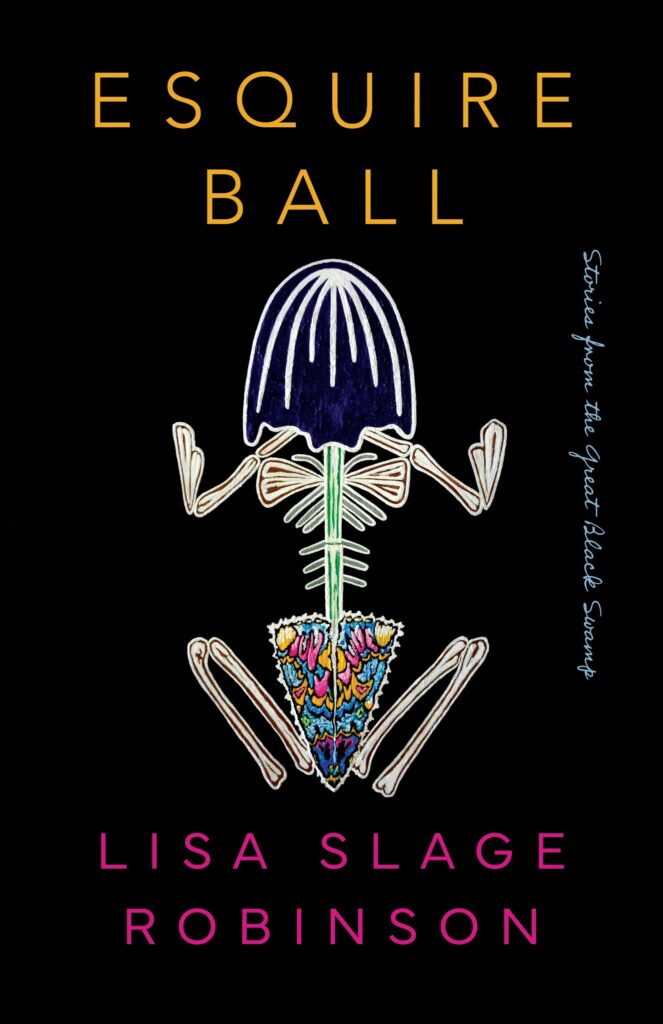
Black Lawrence Press, 2026. Paperback, 180 pages, $17.99. ISBN: 978-1625571809.
Review by Cash Rabley
In her debut short-story collection, Esquire Ball, Lisa Slage Robinson takes readers to the Great Black Swamp, a region of Northwest Ohio where frogs are molded into wives, women trap souls in windows, and a teenager is crushed into the form of a mermaid underneath tons of grain. Throughout the collection, Robinson cuts her surreal fantasies with grittily realistic tales of lawyers and their loved ones, no doubt informed by her own experience as a former attorney. This co-mingling of the surreal and the mundane, married by recurring characters and the almost mythic law firm of Strathy, McMahon, creates a chilling collection of linked Midwest-Gothic tales that never lets you know what to expect next.
Seemingly random at first, every story in Esquire Ball connects in an ornate web that Robinson has woven with the utmost care and precision.
Seemingly random at first, every story in Esquire Ball connects in an ornate web that Robinson has woven with the utmost care and precision. She reveals only tidbits of backstory at a time, leaving readers hungry for the characters’ history from the first story, “Fruits of the Forbidden Tree.” The narrator, unnamed at the time, recalls her hoard of collected (read: stolen) trinkets in a fashion so grimy it’ll make you want to wash your hands. The “macaroni-encrusted and blood-stained tooth” she dug out from under a nine-year-old’s pillow is a particularly gag-inducing example. This “curiosity” is but one of the narrator’s many trophies. The others were taken from Jimmer, Margot, Mrs. Stevens, and her own parents. These names, casually tossed out on the first page, become pivotal in unlocking the secrets of Cecelia Armstrong.
Cissy, as she’s more commonly called, isn’t the only one who graces readers with a narrative in Esquire Ball. The perspective and point of view shift constantly, unveiling characters, calling back to previous stories, and shining a new, though not necessarily brighter, light on those characters who appear throughout. As a result, Esquire Ball reads more like a novel. Readers will grow attached to the recurring cast, recognizing them through mentions of black licorice, their older brothers, and hushed recollections of what happened with “the mailroom guy.” The hints are masterfully placed, disguised as unnecessary details that add characterization or flesh out the setting. These hidden stitches glide through the stories’ fabric until Robinson pulls the thread tight, sending readers flipping backwards through pages looking for something they just know they’ve read before.
These hidden stitches glide through the stories’ fabric until Robinson pulls the thread tight, sending readers flipping backwards through pages looking for something they just know they’ve read before.
The endless tapestry of plants and call-backs makes it impossible to even take a guess at the order in which Robinson wrote the thirteen stories contained within Esquire Ball, many of them previously published as stand-alones. The final piece, “Legend,” which originally appeared in Iron Horse Literary Review in 2025, utilizes the same narrator as a preceding story, “Bird with Lavender Tongue,” published four years prior in Prism International. Rusty plays poker with a slew of characters from across Esquire Ball while recalling his intense sexual experience with a tree and his girlfriend. This woman, a PhD candidate known for changing her name, is almost certainly the same woman that Cissy lets her hair down with in “Devil’s Hole Road” (Storm Cellar, 2021). Where in the book Robinson started, and whether she worked forwards, backwards, or sideways, is indecipherable and inconsequential. Esquire Ball is a final product so smooth you can’t even tell where the pieces interlock.
While not every story contains something as explicitly magical as a revelatory threesome with a tree, even the more mundane tales in Esquire Ball are still anything but normal. Brought to life by Robison’s imaginative prose, they carry a certain sense of the uncanny and the impossible, featuring twists and revelations that leave readers reeling. The Ice Princess’s kiss leaves lips bloody and mutilated in the dark of a file room; the unforgiving legal system further mutilates a maimed man; an affair begins and ends by the movement of giant pandas; and a client shows off her collection of windows that house souls. In Esquire Ball, Robinson summons the surreal in even the most common and concrete. Her description of the lawyer Mad Dog as having something “more like duck feet than paws,” for example, brings a nickname to life while subverting the expected comparison.
The women in these short stories are just as ambitious, clever, and downright dirty as their male counterparts, often even more so.
Through her unbelievably vivid writing, Lisa Slage Robinson draws readers into, and sometimes forces them to become part of, a collection that questions what won’t be done to climb the ranks. Often centering Cissy and her ambition, Esquire Ball showcases magical feminism without compromising its use of complicated characters. The women in these short stories are just as ambitious, clever, and downright dirty as their male counterparts, often even more so. Whether they’re interrogating sick old women, stealing candy from coworkers, or throwing stones at tree spirits, everybody in Lisa Slage Robinson’s work commits their fair share of sins. One thing’s for sure: every character in this collection is guilty of something. There are no angels at the Esquire Ball.

Lisa Slage Robinson writes to explore invisible landscapes and magical feminism. Named a finalist for Midwest Review’s Great Midwest Fiction Contest, her work appears in Iron Horse Literary Review, Smokelong Quarterly, The Adroit Journal, PRISM, Atticus Review, Storm Cellar, Necessary Fiction, Lit Pub, Meat for Tea and elsewhere. A former litigator and corporate attorney, she practiced law in the United States and Canada. Lisa serves on the Board of Directors for Autumn House Press. Born and raised in Ohio, she lives in Pittsburgh with her husband and keeps the lights on for their daughters.
A junior at Western Michigan University, Cash Rabley is studying English literature and language. He completed an internship with Third Coast in Spring 2026. When Cash isn’t working as an RA or on something for his classes, he enjoys reading horror novels and poetry. Cash’s own poetry has been published in The Blank Quill and The Laureate, and he has fiction forthcoming in a Beyond Words anthology.