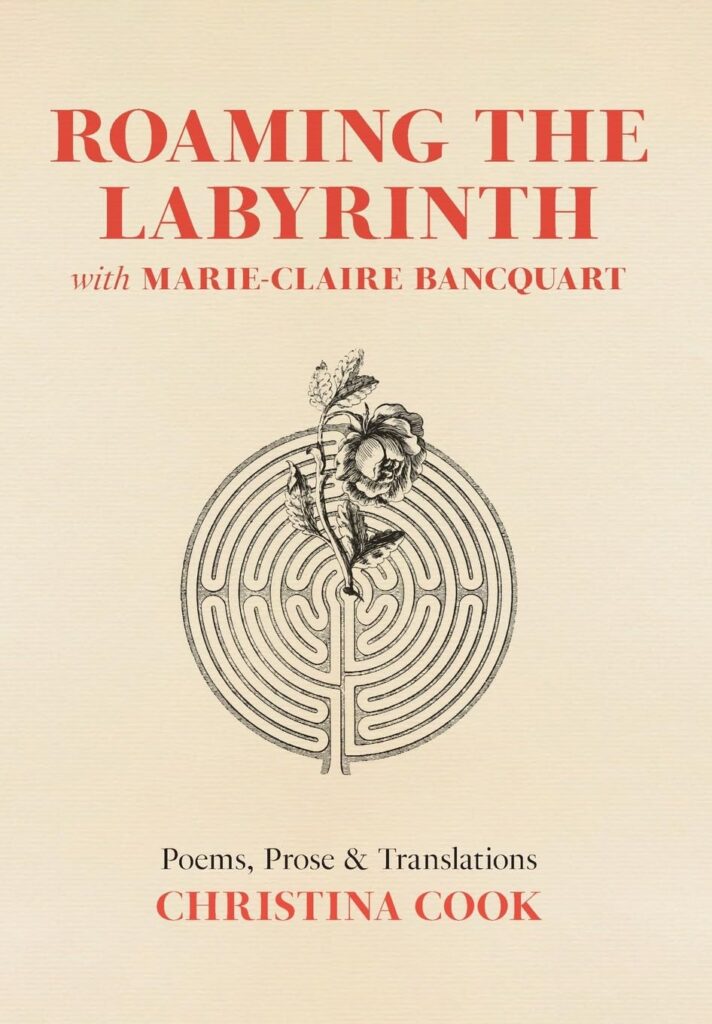
AIM Higher, 2025. Hardcover, 220 pages, $33.00. ISBN 979-8986369945.
Review by Kyra Cochran
Christina Cook’s Roaming the Labyrinth with Marie-Claire Bancquart takes readers on a journey through Paris as the narrative dances through prose and poetry alike, telling stories of myth, death, and the human connection to the living world.
In this collection, Cook seamlessly blends translations of Marie-Claire Bancquart’s bewitching poetry with her own prose and poetry, which is magical in its own right. Readers are transported to an afternoon in Paris that “took on a magical life of its own: one rife with the work of the Bateleur and her mythical entourage.” Cook does not shy away from enchanting imagery, threading magic throughout the mundane as she explores the city—birds sing siren-songs, Cook meets kind and alluring friends, and readers follow her adventure as she explores the winding streets of Paris with poet Marie-Claire Bancquart.
This collection of poems is thoughtfully curated, blending perfectly with Cook’s prose to create a linear narrative. The transitions from memoir to poetry delicately jump from one stone to another down a winding river of memory. Cook has the ability to stretch a poem into something more expansive, using her prose to nestle each poem within the context of its creation. She gives each poem a detailed narrative background, aided with textual analysis. “Death is on your mind because children all around you are dying of the same disease as you. Because it is World War II, and birds aren’t the only things flying through French skies,” writes Cook, depicting Bancquart’s grim childhood in order to set the stage of the book’s prologue.
The transitions from memoir to poetry delicately jump from one stone to another down a winding river of memory. Cook has the ability to stretch a poem into something more expansive, using her prose to nestle each poem within the context of its creation.
This analysis, as well as the narrative portions of the collection, are part of what stand out to me most: this is a story that only Cook could have told. Her fourteen-year friendship with Bancquart has given her profound insight into Marie-Claire’s writing, allowing her to analyze and understand her work in a way no one else could. Cook writes, “Marie-Claire is every bit the Bateleur, bending reality into an arc of unvarnished truth that enters and exits our lungs in what she describes as ‘a concrete respiration that encompasses us all…men, animals, plants, stones, stars.’” Quotations and anecdotes of Cook’s time with Bancquart elevate both the poetry and prose; each translation is carefully done, and each analysis provides insight into Bancquart’s mind.
Cook’s translations of Bancquart’s poetry are attentive and nuanced. “As the translator of French lines,” Cook writes, “I saw the critical importance of disregarding the meanings I’d personally made of the poems in order to create the same collaborative space for Anglophone readers that Marie-Claire had so generously created for her Francophone audience.” Still, Cook knows when to allow readers the space for their own understanding and when a translation might need a little more contextualization than was originally given: Cook writes, “When translating ‘Summer,’ I made a decision that I rarely make as a translator: to replace a word…with more descriptive language…My goal in translating the word was to more closely replicate not the original text, but rather the sensual impression that text made on the source-language reader.”
Tarot and myth thread themselves through this collection, giving it an air of otherworldliness. Several poems are named after specific tarot cards, and the mythological figures of Theseus, Icarus, Eurydice, and others all make appearances. They are approached, however, from an angle that is upside down, or perhaps tilted, as though Bancquart is looking at the myths through a refraction. Of this, Cook writes, “Throughout her poetry and fiction, Bancquart reinvents many mythic characters’ journeys or perspectives in order to breathe expansive new life into their ancient archetypes.” The idea of the mythic is laced into the prosaic narratives as well, with Cook herself taking a sort of mythic journey as she traverses the Parisian streets.
The beauty of Roaming the Labyrinth with Marie-Claire Bancquart is not just the translations of Bancquart’s work; Cook’s style of writing is lavish with imagery, replete with dazzling and provoking descriptions of her own life, as well as her time in Paris. Highlighted at the end of my copy is a beautiful example of Cook’s poetic language:
Before a Coltrane kind of smooth swing breeze blows by, high-brassed whines of a slow moody sax, lips girdling woodwind reeds, Green Dolphin Street slink as black & white & blue in mood as some low grove where Tarots jut from the moss: Star, Tower, Wheel of Fortune, luck in the dark of our jazz vespers, our life-laden houses of cards
Cook’s language is sensual and alluring, inspired, as is Bancquart’s, by myths, tragedies, life, and death. Form is also danced with, done with an emphasis on purpose and engagement in meaning.
Cook also includes her own poetry in this collection, which is inspired by but distinctly different from Bancquart’s work. “In translating Marie-Claire’s poems and coming to know her as an incredible—and incredibly kind and generous—force of nature, I’ve learned that such magic is mine for the taking. That words, especially potent when poetic, are pure magic.” Potent is exactly right—Cook’s language is sensual and alluring, inspired, as is Bancquart’s, by myths, tragedies, life, and death. Form is also danced with, done with an emphasis on purpose and engagement in meaning. One particularly memorable poem, “Tarot: VII. The Chariot,” uses blackout poetry to create a wrenching impact: “I listen as Marie-Claire recounts a story of her city/ too heartbreaking,/ too hard to hear the whole of…” Cook recounts Bancquart’s story on the next page, though large sections are completely blacked out. The impact immediately causes a recoil, the harsh black lines visually representing the destruction that readers are only partially exposed to in rough scraps of brutal description.
Roaming the Labyrinth with Marie-Claire Bancquart is not simply a collection of “Poems, Prose, & Translations” as the cover-page suggests—it is a poignant, rousing narrative of two women from different generations, told through the mysticism of myth and tarot. Readers navigate the labyrinth of life, death, and reality alongside Cook and Bancquart, following their thought processes as they experience the world’s divine and occult perceptions.

Christina Cook is a poet, translator, essayist, novelist, and critic. She is the author of two books: a speculative non-fiction book of poetry, prose, and translation titled Roaming the Labyrinth with Marie-Claire Bancquart (AIM Higher Press, 2025) and the poetry collection, A Strange Insomnia (Aldrich Press, 2016). Cook is currently working on a novel of feminist realism titled American Alchemy. A former speechwriter and writing professor, she lives in San Diego, CA.
Kyra Cochran is a writer, consultant, and editor born and raised in western Michigan. She is graduating with a BA in English Literature and Language. She will soon be living in Montana, where she plans to hike mountains, avoid bears, and write a collection of fiction.